
Information Warriors
- The Battle for Hearts and Minds in the Middle East
By Vyvyan Kinross
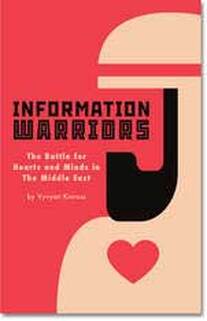
221x142mm, Hardback
ISBN: 978-1-908531-65-0 Price: £19.95 Available: November 2019
About the Author
Vyvyan Kinross is a PR and communications specialist, advising governments on how to set up and manage their information and communications capacity. He has most recently worked in Abu Dhabi, UAE and the Occupied Palestinian Territories. In 2013, he was contracted as Senior Advisor in Public Administration & Organisational Capacity Development at the United Nations Office for Project Services, Copenhagen as an expert in PR & corporate communications systems in fragile and post-conflict states. Vyvyan is a member of the executive of the Council for Arab British Understanding and is a graduate in Modern Arabic Studies from the University of Durham. |
How the hidden information war has helped define the Middle East
A century on from the Paris Peace Conference that redrew the map of the Middle East, and the region has endured constant conflict. Alongside the military and economic wars, the West and Arab states have fought to control public opinion by managing the narratives that explain and validate their actions. This story charts the often hidden information war, from the propaganda coup of the entry of British forces into Jerusalem in 1917 to the campaign of perception management that sold the case for regime change in Saddam’s Iraq in 2003. As the West has embraced the abstractions of public diplomacy and soft power, the propagandists of Islamic State have developed global reach and impact using a simple message and cutting edge digital and social media to generate publicity and harvest recruits. In the Trump era of fake news, media manipulation and cyber warfare, the battle to control public opinion in the post Arab Spring Middle East has raised the stakes for winners and losers. ... some well-known voices on this subject:
‘Indeed there is no question but that government management of opinion is an unescapable corollary of large-scale modern war. The only question is the degree to which the government should try to conduct its propaganda secretly and the degree to which it should conduct it openly’, Propaganda Technique In the World War, Propaganda Organisation, Harold Lasswell, Peter Smith, New York, 1927, p15. ‘From being the most misunderstood nation, America became the most popular. A world that was either inimical, contemptuous or indifferent was changed into a world of friends and well wishers,’ George Creel, How We Advertised America, Harper & Brothers, 1920 ‘It may well be the secret of fascist propaganda that it simply takes men for what they are: the true children of today’s standardised mass culture, largely robbed of autonomy and spontaneity instead of setting goals the realisation of which would transcend the psychological status quo no less than the social one’, Theodor Adorno, Freudian Theory and the Pattern of Fascist Propaganda, Frankfurt Reader, 1951 ‘There is a group of media operatives and companions of the pen that has a prominent and important role in steering the war, shattering the morale of the enemy and raising the spirits of the ummah’, Osama bin Laden, 2002 ‘Interestingly, some compare propaganda to pornography: you can tell it when you see it, but you can’t define it’, Public Diplomacy & Propaganda, Their Differences, John Brown, American Diplomacy, Foreign Service Despatches and Periodic Reports on US Foreign Policy, 2008. ‘We are in a battle and more than half of this battle is taking place in the media’, Abu Musab Al Zarqawi, Leader, Al Qaeda in Iraq ‘Information could have served as a tourniquet in Iraq. With information, an informed Iraqi people could have slowed, if not stopped the societal and cultural violence in their world. There is a direct link between information operations and influencing opinion’, Steven J Alvarez, Selling War, A critical look at the military’s PR machine, p xii, Preface, Potomac Books, 2016 ‘The smart way to keep people passive and obedient is to strictly limit the spectrum of acceptable opinion, but allow very lively debate within that spectrum—even encourage the more critical and dissident views. That gives people the sense that there’s free thinking going on, while all the time the presuppositions of the system are being reinforced by the limits put on the range of the debate.’ The Common Good, Noam Chomsky, Odonian Press, 1998, p43 |
Available now.
Order your copy direct from the publishers to receive a 20% discount. Review coverage |